
The Potential of Solar PV on Rooftops
What Is Canada’s Actual Rooftop Solar Potential?
A July 2024 report from Natural Resources Canada (NRCan) calculates that rooftop solar photovoltaic (PV) could provide 76% of the electricity required to power all residential, commercial and industrial buildings in Canada.
Background
- Canada is among the largest consumers of electricity in the world, ranking fourth on a per capita basis.
- Canada’s annual electricity consumption totaled 546 TWh in 2024, 60% of which was consumed by residential, commercial and industrial buildings (p. 14).
- 19% of Canada’s electricity grid is currently dependent on GHG-emitting sources.
Canada is currently working towards achieving a net-zero electricity grid by 2035 and net-zero emissions as a whole by 2050. To meet these targets, the electricity sector will require increased use of solar PV systems. Solar PV systems will also play a key role in meeting the additional electricity demand—estimated to double by 2050—from Canada’s transition towards electrifying heating and transportation (based on various scenarios that project between 215 GW – 375 GW).
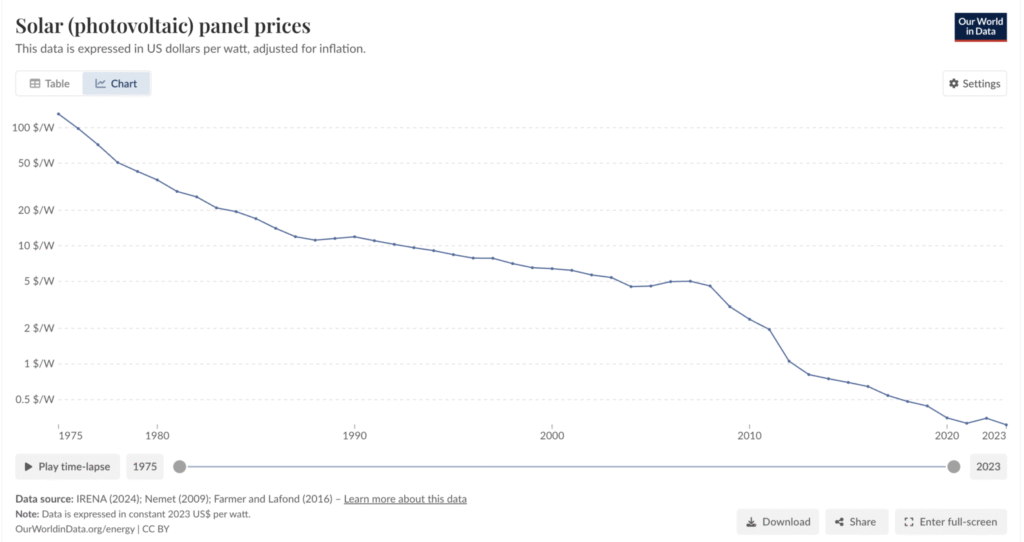
The July 2024 report from NRCan is an important update on the topic of rooftop solar PV potential, following at least three other related reports over the past 20 years.1 A 2006 report determined that solar PV systems with 73,000 MW of installed capacity could meet 29% of Canada’s electricity used by residential, commercial and industrial buildings (p. 1). Since that time, the price of solar PV modules has dropped dramatically while the efficiency has improved significantly, which resulted in the need for new calculations. In response, several other statistical methods, referenced throughout the report, have been applied to understanding solar PV potential which estimated that between 104 GW and 160 GW of solar PV could be installed on rooftops across the country. However, this NRCan report estimates a significantly higher contribution for rooftop solar PV than any of the previous assessments.
Enhanced Calculation Methods
Based on enhanced statistical calculation methods, the authors of the new NRCan report determined that rooftop potential is approximately 300 GW, which would produce 247 TWh2 of electricity per year. This is 76% of the electricity currently required to power all residential, commercial and industrial buildings – or, expressed another way, enough electricity to power all the residential buildings and 49% of the commercial and industrial buildings in Canada (p. 15).3
To put this 300 GW rooftop solar PV number into perspective, 300 GW is double Canada’s 2021 power generation capacity of 149 GW (the NRCan report states that Canada’s total electricity generation capacity was slightly higher in 2024 at 154 GW).
Calculation Details
In performing their calculations, the authors of the new NRCan report focused on the technical potential of rooftop solar PV systems across Canada. They defined the technical potential as “the total amount of electricity that could be generated if all suitable surfaces used solar panels, regardless of financial or logistical criteria, such as the proximity to the power grid, financial costs and supply and demand timing” (p. 4). While these criteria are important, they may change over time. For example, solar module prices can change significantly from year to year, as can government policies from region to region. By separating the technical potential from these other “quasi-economic” factors which informed previous calculations, NRCan attempted to establish a baseline of available power to use for economic and policy analysis.
To develop their estimate of the technical potential of rooftop PV, the report’s authors created a new statistical method (referred to as the CanmetENERGY method) that drew on Light and Detection Ranging (LiDAR) and building footprint data from 11 Canadian municipalities, representing a wide variety of climate conditions and building types. By using more precise data, and only excluding surfaces that were technically unsuitable for PV installation, such as chimneys and vents, this new method provides better estimates of the available rooftop area across Canada and therefore better estimates of Canada’s overall rooftop PV potential than previous studies.
The report also incorporated some additional factors designed to improve the estimates of the available roof area for different building types (e.g., whether the roof is commercial or industrial vs. residential, structural information, building height, and geographic factors).
The new calculation is based on Canada’s current level of housing, but since the number of houses is anticipated to increase in the coming years, the available rooftop space for solar PV will also increase. The calculation didn’t include other solar PV placement options such as putting solar PV on building facades, carports or on industrial and apartment buildings. The authors noted that installing solar PV on building facades would further increase yearly electrical generation by 45 TWh. Moreover, technological advances are expected for solar PV modules, including increased efficiency (p.1).
The report’s authors also observed that residential rooftop solar PV has greater electricity generation capacity than commercial and industrial rooftops, suggesting that residential rooftops will account for 64-70% of the overall generation capacity (p. 14).
Conclusion
This report demonstrates the important contribution that everyday Canadians can make by adopting solar on their homes and businesses, and it helps us understand the important work that rooftop solar installers and suppliers are doing in our communities. Furthermore, a new study published in Nature Climate Change in March 2025 found that widespread implementation of rooftop solar PV around the world could result in a substantial reduction (between 0.05-0.13℃) in global temperatures by 2050. Combined, the NRCan report and the new study show the importance of rooftop solar as a crucial strategy in reducing the effects of climate change around the world.
1The report compares the new CanmetENERGY method with three of the “quasi-economic” methods: 2016 National Renewable Energy Lab Reports (NREL 2016), 2008 National Renewable Energy Lab Reports (NREL 2008), and 2002 International Energy Agency Reports (IEA). However, it mainly focuses on the IEA model for comparison, since that model also includes an estimate of output including areas other than rooftops (referred to as “facades”), and estimates 136 GW without facades and 195 GW with facades.
2 Click here for more info on the difference between W and Wh and what those units denote.
3The report does not distinguish between commercial and industrial.